
Dictionary of Space Concepts
What is the Dictionary of Space Concepts?
The Dictionary of Space Concepts (DSC) is a project by UNIVERSEH – the European Space University of Earth and Humanity. Starting in 2020, this Alliance of five European Universities decided to launch an online dictionary dealing with terms and concepts related to space sciences. It should be created and used by students, lecturers, researchers and citizens alike.
After an initial planning phase, the DSC was published in spring 2022. It opens up several opportunities for all members of the UNIVERSEH Alliance and interested citizens to contribute to the content of the DSC.
In our course "Terms and Concepts of Space" (to the registration) , students learn how to write a dictionary article and later on contribute several entries to the DSC. Students and other members of the UNIVERSEH Alliance can also submit articles for the DSC via an entry in here . Interested citizens can contribute in this entry platform.
Once submitted, these articles are reviewed by UNIVERSEH Alliance staff and, if necessary, edited before their publication in the Dictionary.
In this way, the DSC is a dynamic project that is constantly expanding in content and quality through constant contributions from students, staff and citizens.
Special | A | B | C | D | E | F | G | H | I | J | K | L | M | N | O | P | Q | R | S | T | U | V | W | X | Y | Z | ALL
C |
|---|
CubeSat | ||
|---|---|---|
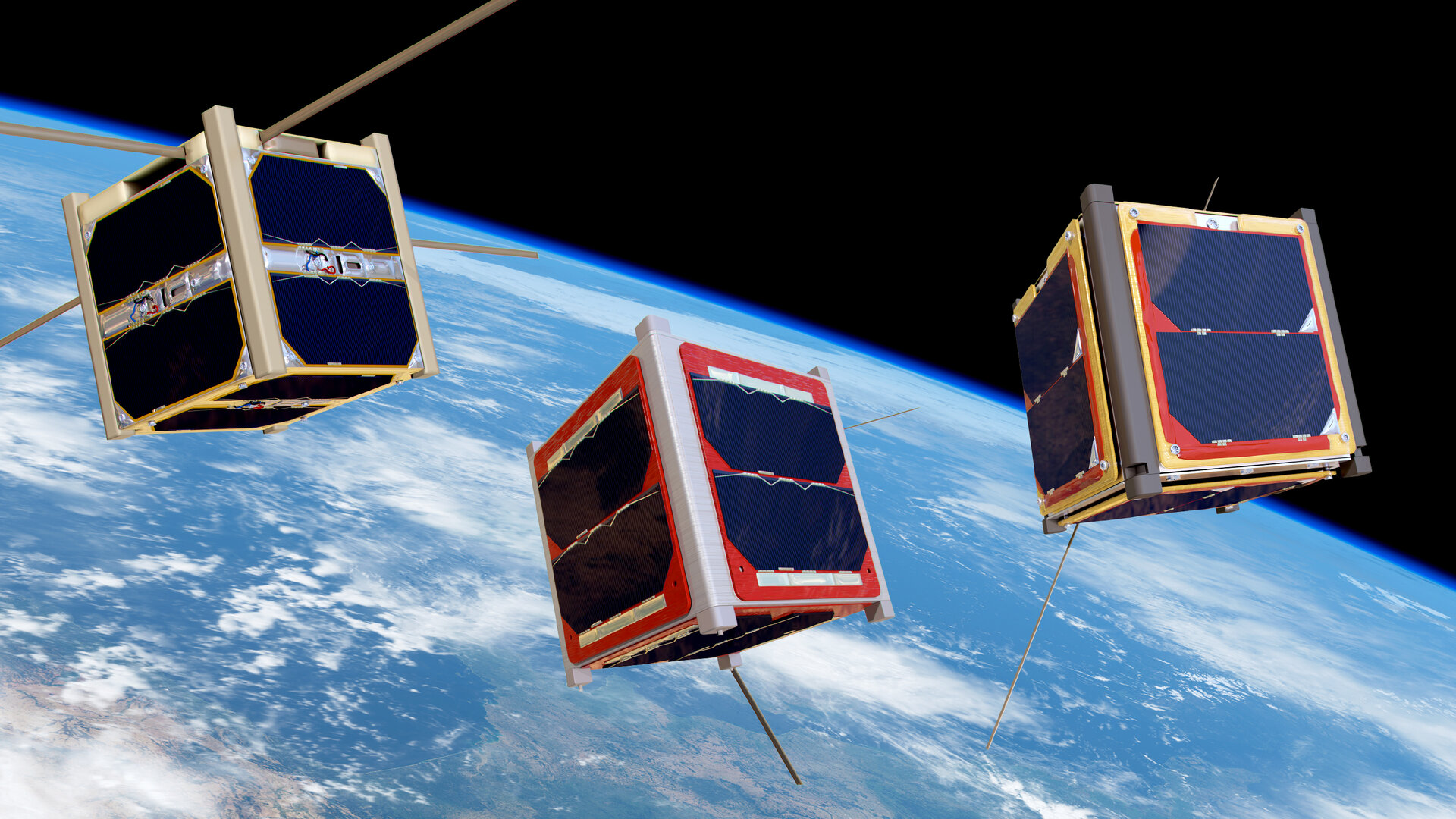 The European Space Agency. (2022, March). CubeSats orbiting Earth. Retrieved from https://www.esa.int/var/esa/storage/images/esa_multimedia/images/2016/04/cubesats_orbiting_earth/15950521-1-eng-GB/CubeSats_orbiting_Earth_pillars.jpg Short definition: CubeSat (Cube Satellite) is a spacecraft that is meant to be a planet's artificial satellite and is designed as a cubic case. The purpose of such case is to carry its payload. Detailed Definition CubeSat is a nanosatellite. It is built as a cube with standard dimension, length of each side is a multiple of 10cm or 1U. They can contain arbitrary payload, usually scientific equipment such as small cameras. Their usual weight is about 1.3 kilograms, what makes them relatively cheap to launch and hence widely accessible. Their accessibility allows smaller players in space industry such as companies and even universities to deploy their space exploration tools into space. Etymology Cube SatelliteCube – from Latin cubusSatellite – from Latin satellitem– an attendant Sample Sentences "These CubeSats are flown as auxiliary payloads on previously planned missions."NASA. (2018, February). CubeSats Overview. Retrieved from https://www.nasa.gov/mission_pages/cubesats/overview Translations in our Alliance languages: French: CubeSatGerman: CubeSat Italian: CubeSat Polish: CubeSat Swedish: CubeSat Translations in other languages: Russian: КубСат References The European Space Agency. (2022, March). CubeSats. Retrieved from https://www.esa.int/Enabling_Support/Preparing_for_the_Future/Discovery_and_Preparation/CubeSats Cal Poly SLO. (2014, February). CubeSat Design Specification Rev. 13. Retrieved from https://static1.squarespace.com/static/5418c831e4b0fa4ecac1bacd/t/56e9b62337013b6c063a655a/1458157095454/cds_rev13_final2.pdf | ||