UNIVERSEH
  • Home
  • Get support
  • More
English ‎(en)‎
Deutsch ‎(de)‎ English ‎(en)‎ Français ‎(fr)‎ Italiano ‎(it)‎ Lëtzebuergesch ‎(lb)‎ Polski ‎(pl)‎ Svenska ‎(sv)‎
Log in
UNIVERSEH
Home
Get support
  1. Site pages
  2. Dictionary of Space Concepts

Dictionary of Space Concepts

Back

Chandrasekhar limit

(Last edited: Friday, 1 September 2023, 12:48 PM)
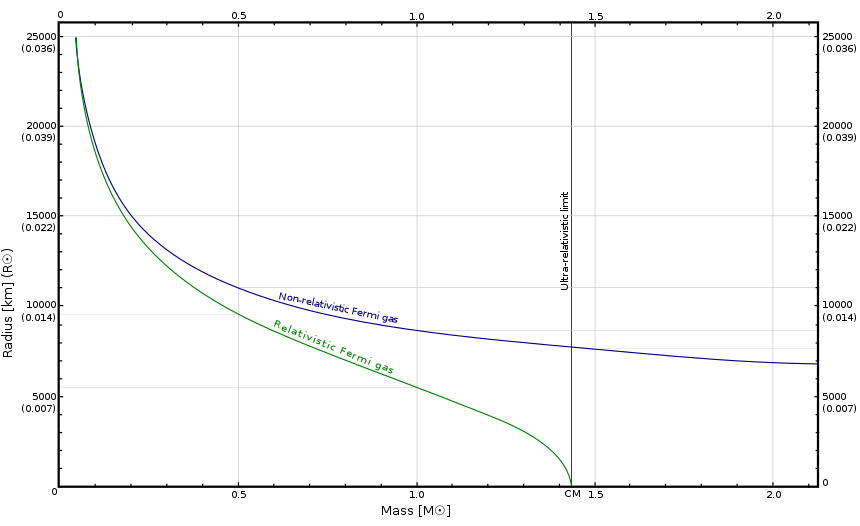
https://edu.universeh.eu/pluginfile.php/1501/mod_glossary/entry/965/Chandrasekhar%20limit.png Creator : Unknown Year: (n.d.) Title of image: White Dwarf Mass-Radius Relationship Description of image: Graph illustrating the mass-radius relationship of white dwarf stars Retrieved from URL: https://upload.wikimedia.org/wikipedia/commons/thumb/1/14/WhiteDwarf_mass-radius_en.svg/860px-WhiteDwarf_mass-radius_en.svg.png

Creator : Unknown Year: (n.d.) Title of image: White Dwarf Mass-Radius Relationship Description of image: Graph illustrating the mass-radius relationship of white dwarf stars Retrieved from URL: https://upload.wikimedia.org/wikipedia/commons/thumb/1/14/WhiteDwarf_mass-radius_en.svg/860px-WhiteDwarf_mass-radius_en.svg.png


Definitions


Short Definition

The Chandrasekhar limit is a fundamental concept in astrophysics that determines the maximum mass a white dwarf star can attain. It is named after the Indian astrophysicist Subrahmanyan Chandrasekhar, who proposed this limit in 1930. According to the Chandrasekhar limit, if a white dwarf exceeds about 1.4 times the mass of the Sun, it will collapse under its own gravity, leading to a catastrophic event such as a supernova explosion.


Detailed Definition

The Chandrasekhar limit is the maximum mass that a white dwarf star can have before it undergoes a collapse and explodes in a type of supernova known as a Type Ia supernova. This limit was first proposed by Indian astrophysicist Subrahmanyan Chandrasekhar in 1930, who showed that if a white dwarf exceeds a certain mass, the pressure generated by electrons in the star's core can no longer balance the force of gravity, causing the star to collapse under its own weight.

The Chandrasekhar limit is currently estimated to be about 1.4 times the mass of the Sun. When a white dwarf reaches this mass, it can no longer support itself through electron degeneracy pressure and instead collapses into a neutron star or black hole. The collapse generates a tremendous amount of energy, which is released in a supernova explosion.


Etymology

This term was first proposed by Indian astrophysicist Subrahmanyan Chandrasekhar in 1930.

Sample Sentence(s)


Please provide 1-2 sample sentences using the term/concept in its appropriate scientific context and most common usage.


The Chandrasekhar limit determines whether a star ends its life as a smoldering white dwarf, or explodes in a supernova to become a neutron star or black hole.

Author : Staff, Space.com Year: (n.d.) Title of the article: Chandrasekhar Limit: Definition, Facts & Equation Title of the Website: Space.com Retrieved Date: May 29, 2023 URL: https://www.space.com/chandrasekhar-limit


Translations of Terms/Concepts into Partner Languages


French

La masse de Chandrasekhar


German

das Chandrasekhar- Grenze


Italian

Limite di Chandrasekhar


Polish
granica Chandrasekhara


Swedish

Chandrasekhargränsen

Additional Translations of Terms/Concepts into Other Lang...


Russian: Предел Чандрасекара


Links to Videos/Articles:

oxYbShKkw-4

https://www.toppr.com/guides/physics/astronomy/chandrasekhar-limit/

Author(s): Unknown Year: (n.d.) Title of the article: Chandrasekhar Limit Title of the Website: Toppr.com Retrieved Date: May 29, 2023, URL: https://www.toppr.com/guides/physics/astronomy/chandrasekhar-limit/


» Dictionary of Space Concepts

Tags:
  • dwarf star
  • supernova
  • Astrophysics
  • gravity
  • Sun
◄ Site announcements
You are not logged in. (Log in)
Powered by Moodle
UNIVERSEH is an alliance of:
Université de Toulouse logo AGH logo UDUS logo LTU logo Uni.lu logo UNamur logo Tor Vergata logo

Co-funded by European Union

© Copyright UNIVERSEH 2026

Privacy notice information


All rights reserved. Funded by the European Union. Views and opinions expressed are however those of the author(s) only and do not necessarily reflect those of the European Union or the European Education and Culture Executive Agency (EACEA). Neither the European Union nor the granting authority can be held responsible for them.