UNIVERSEH
  • Home
  • Get support
  • More
English ‎(en)‎
Deutsch ‎(de)‎ English ‎(en)‎ Français ‎(fr)‎ Italiano ‎(it)‎ Lëtzebuergesch ‎(lb)‎ Polski ‎(pl)‎ Svenska ‎(sv)‎
Log in
UNIVERSEH
Home
Get support
  1. Site pages
  2. Dictionary of Space Concepts

Dictionary of Space Concepts

Back

Terrestrial Planets

(Last edited: Monday, 2 October 2023, 7:14 PM)


Short Definition
Terrestrial planets are rocky planets with solid surfaces, composed mainly of silicate rocks and metals. They are considered potentially habitable due to their location within the habitable zone of their star, this means that they are located at a distance from their star where the temperature is neither too hot nor too cold for liquid water to exist.


Detailed Definition

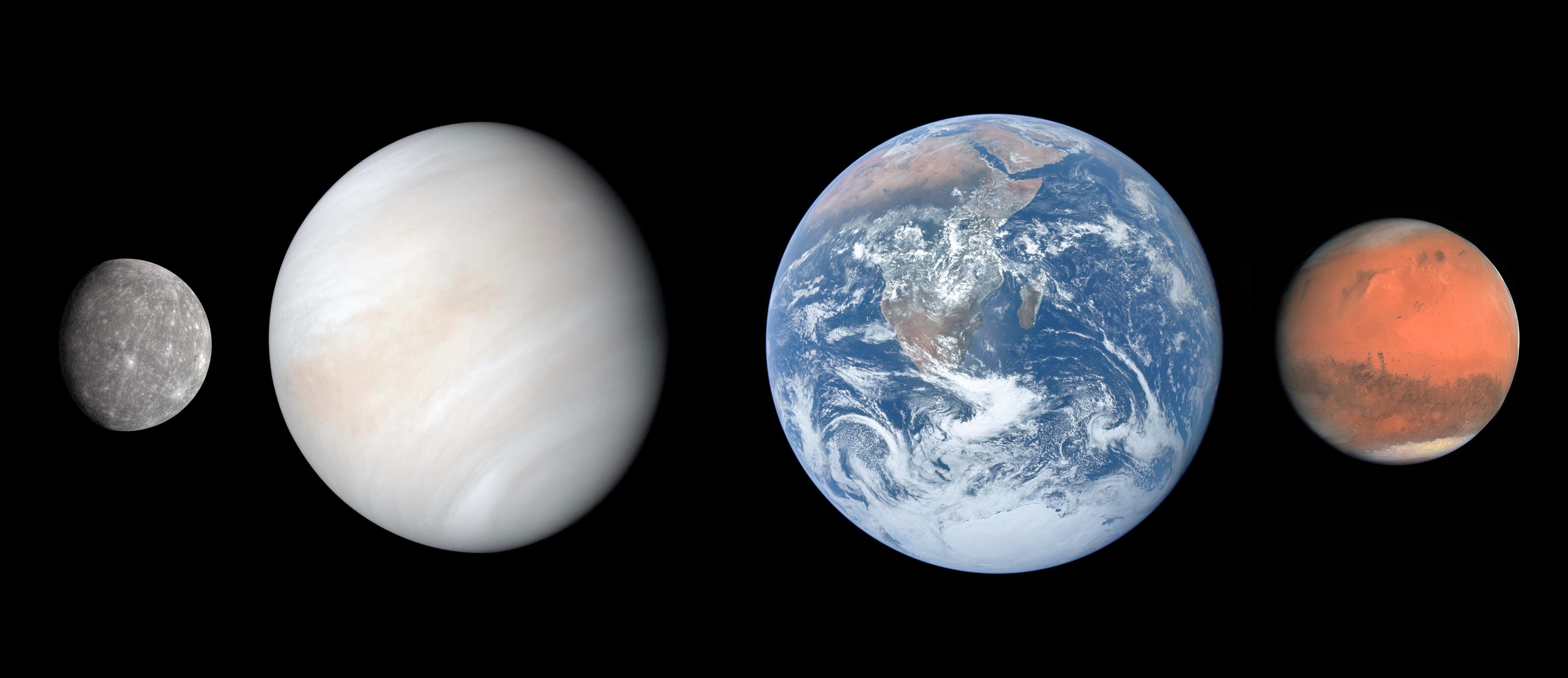
Terrestrial planets include Earth, Venus, Mars, and Mercury and typically have thin or no atmospheres, distinguishing them from gas giants. With relatively high densities compared to gas giants, terrestrial planets tend to exhibit a wide range of geological features, such as mountains, valleys, and impact craters.
Additionally, their relatively high densities contribute to their stronger gravitational pull, which affects not only their overall structure but also the dynamics of their planetary systems. It is likely that there were more terrestrial planets during the formation of our solar system, but they either merged with each other or were destroyed. Their unique characteristics and potential for habitability make terrestrial planets a subject of ongoing scientific study and appealing for potential colonization by humans in the future.


Etymology

The term "terrestrial planets" originates from the Latin word "terra," which means "earth" or "land." The word "terrestrial" itself is derived from the Latin adjective "terraeus," meaning "of the earth."

The word "planet" has its roots in ancient Greek. It comes from the Greek term "planētēs," which means "wanderer" or "wandering star."

Sample Sentence(s)

"It's unclear what the dividing line is between a rocky planet and a terrestrial planet."


Dutfield, S., & Gammon, K. (2022). Terrestrial planets: Definition & facts about the inner planets and beyond. Space.com. https://www.space.com/17028-terrestrial-planets.html


Translations of Terms/Concepts into Partner Languages

French
Planète tellurique

German
Terrestrische Planeten or Erdähnlicher Himmelskörper

Italian
Pianeta terrestre

Polish
Planety skaliste, planety typu ziemskiego

Swedish
Stenplanet


Additional Translations

Spanish

Planeta terrestre

Turkish

Karasal gezegen

Dutch

Aardse planeten


Links to Videos/Articles

Dutfield, S., & Gammon, K. (2022). Terrestrial planets: Definition & facts about the inner planets and beyond. Space.com. https://www.space.com/17028-terrestrial-planets.html

Morbidelli, A., Lunine, J. I., O’Brien, D. P., Raymond, S. N., & Walsh, K. J. (2012). Building Terrestrial Planets. Annual Review of Earth and Planetary Sciences, 40(1), 251–275. https://doi.org/10.1146/annurev-earth-042711-105319

Terrestrial | Planet Types – Exoplanet Exploration: Planets Beyond our Solar System. (n.d.). Exoplanet Exploration: Planets Beyond Our Solar System. https://exoplanets.nasa.gov/what-is-an-exoplanet/planet-types/terrestrial/

Cornerstone Television Network. (2015, October 8). Origins: The Terrestrial Planets [Video]. YouTube.

watch

MooMooMath and Science. (2019, August 22). Terrestrial Planets in Order [Video]. YouTube.

watch


» Dictionary of Space Concepts

Tags:
  • astronomical body
  • planet
  • Mecure
  • Earth
  • Venus
  • Mars
  • Terrestrial
  • Habitable
  • Solar System
  • universe
◄ Site announcements
You are not logged in. (Log in)
Powered by Moodle
UNIVERSEH is an alliance of:
Université de Toulouse logo AGH logo UDUS logo LTU logo Uni.lu logo UNamur logo Tor Vergata logo

Co-funded by European Union

© Copyright UNIVERSEH 2026

Privacy notice information


All rights reserved. Funded by the European Union. Views and opinions expressed are however those of the author(s) only and do not necessarily reflect those of the European Union or the European Education and Culture Executive Agency (EACEA). Neither the European Union nor the granting authority can be held responsible for them.