UNIVERSEH
  • Home
  • Get support
  • More
English ‎(en)‎
Deutsch ‎(de)‎ English ‎(en)‎ Français ‎(fr)‎ Italiano ‎(it)‎ Lëtzebuergesch ‎(lb)‎ Polski ‎(pl)‎ Svenska ‎(sv)‎
Log in
UNIVERSEH
Home
Get support
  1. Site pages
  2. Dictionary of Space Concepts

Dictionary of Space Concepts

Back

Rocket engine

(Last edited: Monday, 2 October 2023, 5:52 PM)

Image

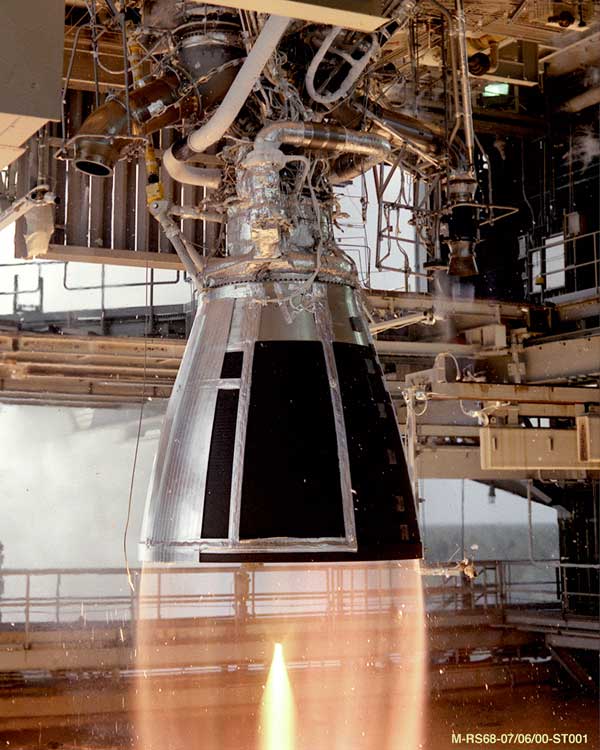
Image NASA. (2000, January). RS-68 being tested at NASA's Stennis Space Center. Retrieved from https://www.nasa.gov/images/content/148709main_d4_testing_08.jpg Photograph of a rocket engine in operation, with a converging plume of hot gas streaming out from the nozzle

Image NASA. (2000, January). RS-68 being tested at NASA's Stennis Space Center. Retrieved from https://www.nasa.gov/images/content/148709main_d4_testing_08.jpg Photograph of a rocket engine in operation, with a converging plume of hot gas streaming out from the nozzle

Short Definition

A rocket engine is a jet engine that discharges a jet of high-temperature gas as reaction mass, which was acquired from the propellant stored internally in a vehicle. Rocket engines, unlike general jet engines, can only use internally stored propellant to create a jet, because they have to operate in space, where there is no medium like air or water which can be used as a reaction mass in jet engines on Earth.

Detailed Definition

A rocket engine is an internal combustion jet engine that discharges a jet of high-temperature gas as reaction mass, which was acquired from the propellant stored internally in a vehicle. Rocket engines, unlike general jet engines, can only use internally stored propellant to create a jet of gas as a result of chemical reactions, because they have to operate in space, where there is no medium like air or water which can be used as a reaction mass in jet engines on Earth. The nozzle is always an integral part of a rocket engine because it makes the jet accelerate as gas moves through the nozzle, and the higher the speed of a discharged jet, the more efficient the engine. The de Laval nozzle is the most common type of nozzles used in rocket engines, as it accelerates the gas passing through it most efficiently. Gas, when burnt, moves at a low subsonic speed and accelerates as it moves through the nozzle, reaching supersonic speed by the moment it leaves the nozzle.

Etymology

Rocket – from Old Italian rochetto– a bobbinEngine – from Middle English engyn or Anglo-Norman engine or Old French engin– skill, cleverness, war machine

Sample Sentences

The rocket engine ignited with a powerful roar, propelling the spacecraft into space.

Translations from our alliance partners' languages:

French: Moteur-fusée
German: Raketentriebwerk
Italian: Motore a razzo
Polish: Silnik rakietowy
Swedish: Raketmotor

Other language translations:
Russian: Ракетный двигатель
Ukrainian: Раĸетний двигун
Belarusian: Ракетны рухавік

References

Braeunig, R. A. (2012). Rocket propulsion. Retrieved from http://www.braeunig.us/space/propuls.htm

Oberth, H. (1972, January). Ways to spaceflight. Retrieved from https://archive.org/details/nasa_techdoc_19720008133/page/n35/mode/2up


» Dictionary of Space Concepts

Tags:
  • engine
  • rocket
  • propulsion
◄ Site announcements
You are not logged in. (Log in)
Powered by Moodle
UNIVERSEH is an alliance of:
Université de Toulouse logo AGH logo UDUS logo LTU logo Uni.lu logo UNamur logo Tor Vergata logo

Co-funded by European Union

© Copyright UNIVERSEH 2026

Privacy notice information


All rights reserved. Funded by the European Union. Views and opinions expressed are however those of the author(s) only and do not necessarily reflect those of the European Union or the European Education and Culture Executive Agency (EACEA). Neither the European Union nor the granting authority can be held responsible for them.