UNIVERSEH
  • Home
  • Get support
  • More
English ‎(en)‎
Deutsch ‎(de)‎ English ‎(en)‎ Français ‎(fr)‎ Italiano ‎(it)‎ Lëtzebuergesch ‎(lb)‎ Polski ‎(pl)‎ Svenska ‎(sv)‎
Log in
UNIVERSEH
Home
Get support
  1. Site pages
  2. Dictionary of Space Concepts

Dictionary of Space Concepts

Back

Umbra

(Last edited: Sunday, 1 October 2023, 2:43 PM)


Source:


Short definition: 

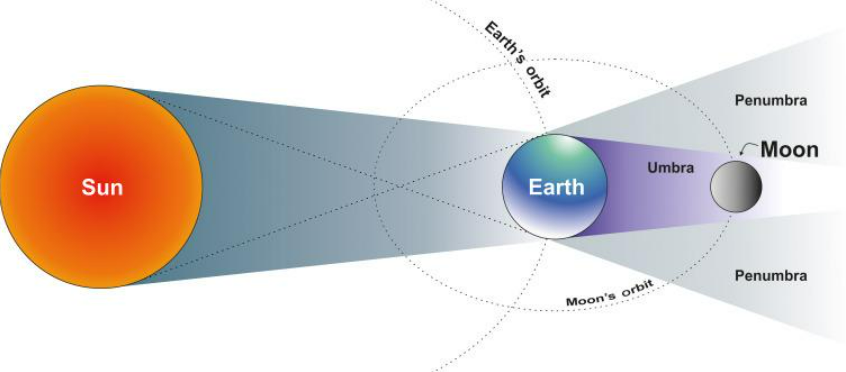
The umbra is the innermost and darkest part of a shadow, where light is completely blocked by an object. In the context of astronomy, the umbra is often observed during a solar eclipse, when the Moon's shadow is cast on the Earth.

Detailed Definition:

The Umbra is the innermost and darkest part of a shadow. It is the area where light is completely blocked by an object, such as a planet or moon. When a celestial body, passes between a star and another celestial body, it can cast a shadow on that body. The umbra is the part of the shadow that is directly behind the blocking body. The lighter part of the shadow - penumbra, is the area where only part of the light is blocked. The umbra and penumbra can be observed during a solar eclipse, when the Moon's shadow is cast on the Earth.

Etymology:

Umbra (Latin) - shadow

Sample Sentence(s):

"Terms "umbra" and "penumbra" are not limited to celestial bodies, they occur in shadows of everyday objects."

"During solar eclipse, when an observer stands in umbra, dusk seems to set from all directions on the horizon at once."

Translations:

German:

Umbra

Polish:

Cień całkowity

Links to videos/articles:

https://www.universetoday.com/155274/astronomy-jargon-101-umbra/


» Dictionary of Space Concepts

Image (PNG) Screenshot 2023-01-08 173811.png
Tags:
  • planet
  • solar eclipse
◄ Site announcements
You are not logged in. (Log in)
Powered by Moodle
UNIVERSEH is an alliance of:

Université de Toulouse logo AGH logo UDUS logo LTU logo Uni.lu logo UNamur logo Tor Vergata logo

Co-funded by European Union

© Copyright UNIVERSEH 2026

Privacy notice information


All rights reserved. Funded by the European Union. Views and opinions expressed are however those of the author(s) only and do not necessarily reflect those of the European Union or the European Education and Culture Executive Agency (EACEA). Neither the European Union nor the granting authority can be held responsible for them.